Friday, October 23, 2009

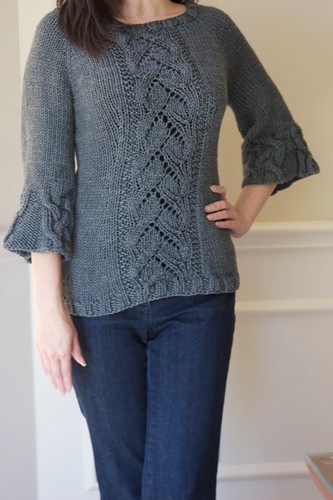
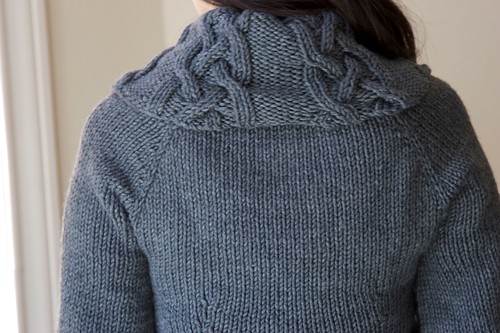
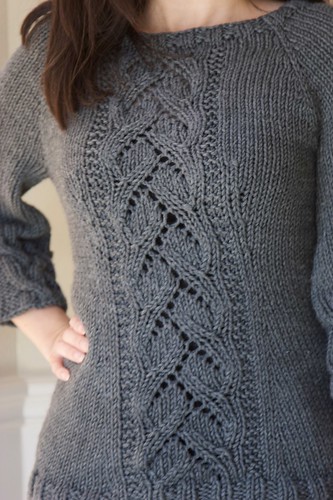
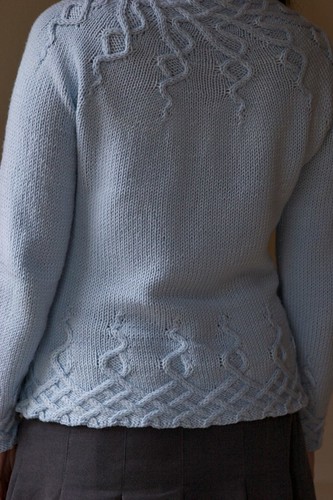
Vine Lace Cardigan


Completed: October 2009

Pattern: Vine Lace Cardigan, by SweaterBabe

Yarn: Cascade Ecological Wool (100% wool), #9004, 1.5 x 478y/250g

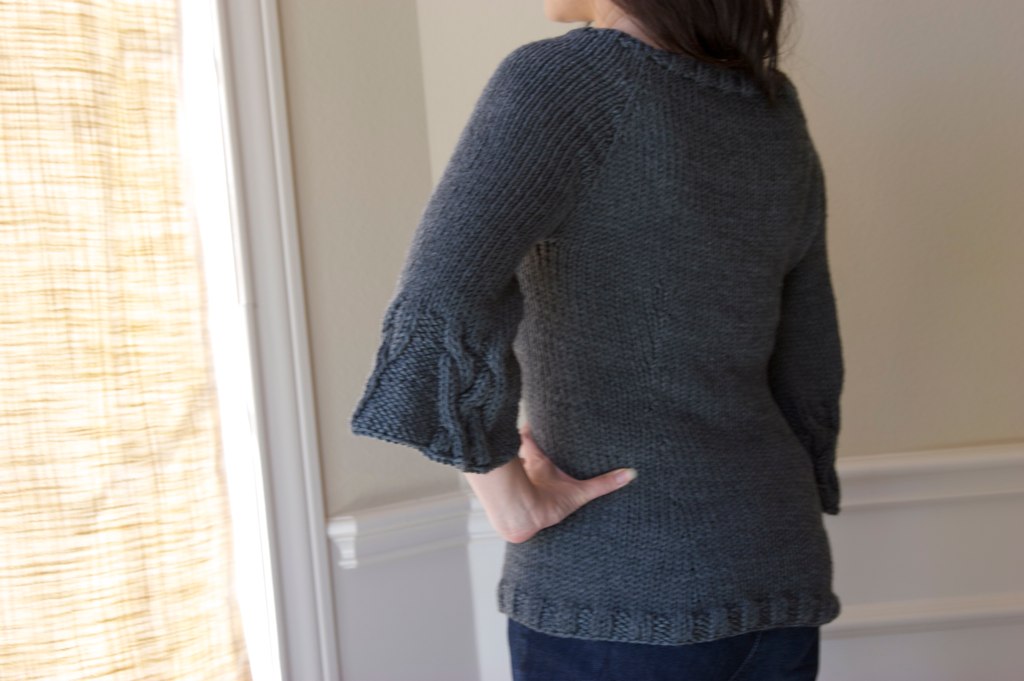
Notes: Knitting size M at 3.5 st/in gauge gives me a 35” cardi, which is a better sze for me than the 40” that the pattern offers at the smallest size. Luckily, the row gauge is only slightly off, and I wanted it shorter anyway, so I didn’t have to make any modifications there. My sweater fits more like a regular cardi than a sweater coat.

For the raglan increases without a stitch in between them, I prefer to do a KLL and KRL, rather than doing 2 consecutive m1’s.


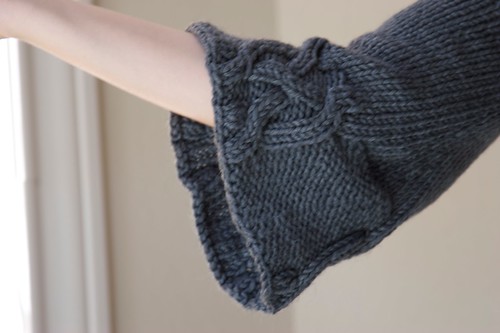
I joined the body pieces first, instead of doing the sleeves first. It’s just easier for me to visualize how I want the sleeves to be if the body is already done and I can put it on. After the body was done the sleeves were knit in the round, picking up the necessary stitches from the body (this meant no seaming at the armpit later). The sleeves were knit straight, without any increases.

I did 3 sets of decreases for the waist (only on RS rows) and knit the ribbing section straight, without any shaping. I waited till row 56 to start the ribbing so that the buttonhole that is supposed to be made on row 62 (for size M) would be vertically centered in the ribbing section. I really liked that little tweak, but I think if you are actually knitting the pattern at row gauge, it may not work for you since the ribbing section may sit too low across your abdomen and not be flattering. After the ribbing section, I made 4 sets of increases for the waist so that the hips were a bit bigger than the chest.

I was initially tempted to leave off the pockets, but I’m so glad I made them. They are soooo cute! I did add an extra selvedge stitch on each side to make the seaming up a bit neater.


I’m very pleased with the results. This is the type of sweater that I can throw over just about anything, and I know I’ll grab for it often. The pattern was clear, but personally, I’m not a fan of how each row is spelled out for the first section of the pattern. At the least, it could have been simplified to say that all the WS rows were worked the same.

Tuesday, September 22, 2009

Ingenue


Completed: July 2009

Pattern: Ingenue, Custom Knits, by Wendy Bernard

Yarn: Cascade 220 Superwash (100% wool), #1910, 4 x 220y/100g

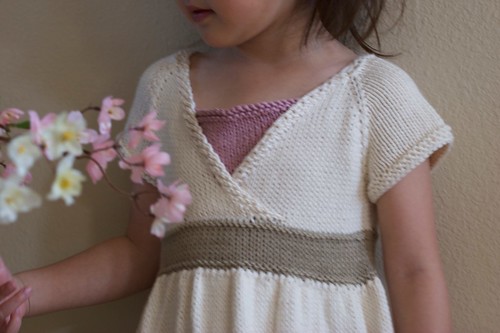
Notes: I was adventurous and started this without doing a swatch first. I figured it wouldn’t be too big of a deal since it’s a top-down raglan and adjustments are relatively simple to make. I made the collar on size 7’s and realized the gauge was too small, but I like the way the collar turned out anyway, so I left it alone. I switched to size 8’s once I got to the yoke to get closer to gauge but it was still smaller, at 20st/24r.


I knit the collar in as I went along, rather than waiting to sew it in at the end. For the raglan increases on the yoke, I spaced them further apart towards the end. After the 12th increase, I set them every 3rd row instead of every other. In part, this was to help make up my row gauge difference, but it also changed the slope of the increase and helps to prevent some of that fabric excess that often happens near the armpit on raglans. I picked this up from knitting Hargreave’s Jasmine, and I think it makes for nice shaping. As you can see in the picture with my arms down, there is still some bunching, but not too terrible. I like the way the waist shaping is done in the front and back just under the bust and at the sides along the hip. I think I will use this method in future sweaters.


I had some trouble with the bottom hem flipping up. It didn’t curl-–it just kept flipping up after I sat down or if I bent at the waist. So to try and fix this, I did the hem a bit differently. It was fiddly to get the tension just right, but I’m okay with how it turned out. After knitting row 4 of the pattern (I only did 3 repeats)…
-Knit 1 row
-Purl 1 row (turning ridge)
-Knit 2 rows using 1 needle size down
-Turn hem in along turning ridge and sew live stitches to wrong side of fabric


I didn’t have any problems with the sleeve hems flipping up, but nevertheless, I did those hems in a similar way, just for consistency. The only difference was that on the sleeves, I went down 1 needle size starting on row 4 of the last pattern repeat and also decreased by 2 stitches on that row. After purling 1 row for the turning ridge, I kept the same needle size but decreased another 2 stitches on the next knit row.


The yarn is really nice and easy to work with. It doesn’t feel plasticky like some other superwash yarns. It’s pretty soft and comfortable to wear. I think most people could easily wear it next to their skin, but I’m extra sensitive, so I did feel more comfortable with a tank on underneath.

Monday, September 21, 2009

Uni


Completed: September 2009


Pattern: Hobby Horse, by Ann Budd

Yarn:

  • Cascade 220 Heathers #2453 (100% wool), 0.3 x 220yd/100g
  • Cascade 220 #7805 (100% wool), 1 x 220yd/100g
  • Cascade 220 #8686 (100% wool), 0.25 x 220yd/100g
  • Imperial Stock Ranch Lopi #01 (100% wool), 0.3 x 113yd/100g


    Notes: I am no sock knitter, so I’m not sure if it’s a mistake or not, but I believe the first decrease on the gusset should be a k2tog, rather than a ssk. I guess it doesn’t matter all that much since it’s felted.

    When making the face, I first knit 1 round before starting the basketweave stitch pattern. This avoided weird purl bumps of the MC showing through on the first round of the basketweave. The pattern calls for k2p2 as the stitch pattern, but the picture looks like it’s a k4p4, so that’s what I did instead. After finishing the face, I did a 1/2 round to move the remaining color transitions to the underside of the face to make them less obvious.

    The only other minor thing I found was that the diagram of the bridle doesn’t really correspond to what’s pictured. No big deal, though. I will confess that I bought some decorative cord to use for the bridle rather than making I-cord, and I used just regular yarn to close off the bottom instead of making a crochet chain. Why? ‘Cause life is short and my queue is long! :-)

    I used the Imperial Stock Ranch Lopi because I wanted a natural-colored yarn, and I already had it on hand. It did not felt nearly as well as the Cascade 220, though, and I wish I had gone ahead and bought more 220 instead.

    I did the stripes on the neck a little differently, but the main modification I made to this pattern was to add a horn. It’s attached with velcro rather than sewn on, just so my little one has the option of choosing what kind of steed she wants to ride that day. The “hair” for the forelock area was arranged in a V-shape (basically like an inverted widow’s peak), creating a comb-over that hides the velcro. The soft side of the velcro is sewn to the head and the hard side is sewn to the bottom of the horn, to avoid having the hair snag on the velcro when the horn is not in place. The pieces of yarn that make up the forelock at 8" long and the yarn for the rest of the mane is 10" long.


    CO 24sts. Join to knit in the round
    1: k10, p2, k10 , p2
    2: k9, p2, k10 p2, k1
    3: k8, p2, k10, p2, k2
    4: k7, p2, k10, p2, k3
    5: k6, p2, k10, p2, k4
    6: k5, p2, k10, p2, k5
    7: k3, p2tog, p1, k9, p2tog, p1, k6
    8: k2, p2, k9, p2, k7
    9: k1, p2, k9, p2, k8
    10: p2, k9, p2, k9
    11: p1, k9, p2, k9, p1
    12: k8, p2tog, p1, k8, p2tog, p1
    13: k7, p2, k8, p2, k1
    14: k6, p2, k8, p2, k2
    15: k5, p2, k8, p2, k3
    16: k4, p2, k8, p2, k4
    17: k2, p2tog, p1, k7, p2tog, p1, k5
    18: k1, p2, k7, p2, k6
    19: p2, k7, p2, k7
    20: p1, k7, p2, k7, p1
    21: k6, p2tog, p1, k6, p2tog, p1
    22: k5, p2, k6, p2, k1
    23: k4, p2, k6, p2, k2
    24: k3, p2, k6, p2, k3
    25: k1, p2tog, p1, k5, p2tog, p1, k4
    26: p2, k5, p2, k5
    27: p1, k5, p2, k5, p1
    28: k4, p2tog, p1, k4, p2tog, p1
    29: k3, p2, k4, p2, k1
    30: k2, p2, k4, p2, k2
    31: p2tog, p1, k3, p2tog, p1, k3
    32: p1, k3, p2, k3, p1
    33: k3, p2, k3, p2
    34: k1, p2tog, p1, k2, p2tog, p1, k1
    35: p2, k2, p2, k2
    Break yarn and weave tail through remaining stitches.

    Now, you have to decide whether you like the inside or the outside better. Personally, I liked the side with mostly purl stitches better, so I turned it inside out. If you want to only make a unicorn, you can sew this onto the head after each is felted, stuffing it before you finish up the seam. If you want a “convertible” horn, you’ll need to make a base for the horn.

    CO 6sts. Join to knit in the round
    1: knit
    2: kfb each stitch (12 sts)
    3: knit
    4: knit
    5: kfb each stitch (24sts)
    6: knit
    BO.


    Felt all the pieces separately and then saw the base onto the horn, stuffing it before you finish up the seam. Sew the hard side of the velcro onto the base of the horn and the soft side onto the horse’s head.

  • Wednesday, September 16, 2009

    Lizzie


    Completed: September 2009

    Pattern: Lizard, by Amy-Lynne Mitchell

    Yarn: Spud & Chloe Sweater (55% superwash wool, 45% organic cotton), #7507, 2.5 x 160yd/100g

    Notes: I wanted to make a stole for my friend. Since her name is Liz and she likes lizards, I wanted to include a graphic and thought this dishcloth pattern would be just right. Basically, I just added a bit of garter and some eyelets to the bottom edge, followed the pattern, added a bunch of stockinette to the middle, and then repeated the lizard motif and edging. Easy peasy! The finished stole was about 5' x 1'.


    This was my first time working with the Sweater yarn. The colors are rich and beautiful, but some of the color does come off in the wash–so be careful. The feel is nice and soft, not plasticky like some other superwash yarns.

    Sunday, August 30, 2009

    Babs


    Completed: August 2009


    Pattern: Knit Chickens, by Susan B. Anderson, and chart by Michelle Mooney

    Yarn:

  • Cascade 220 Heathers #2453 (100% wool), 0.3 x 220yd/100g
  • Cascade 220 #9476 (100% wool), 0.3 x 220yd/100g
  • Cascade 220 #9404 (100% wool), 0.2 x 220yd/100g
  • Cascade 220 #7824 (100% wool), just a bit x 220yd/100g

    Notes: I made another chicken following ElleM’s awesome chart, just using a different color scheme. My first one was made as a gift, and this one I made for myself and wanted her to match my kitchen.

    I constructed this one in the same way as Henrietta. The only other thing I’ll mention is that I find it helpful to put a layer of polyfill on the bottom before pouring in the pellets–helps to keep them from working their way out.

    She is named after Babs, the knitting chicken from the movie Chicken Run. It's not meant to look like the original Babs, just an homage :-)